
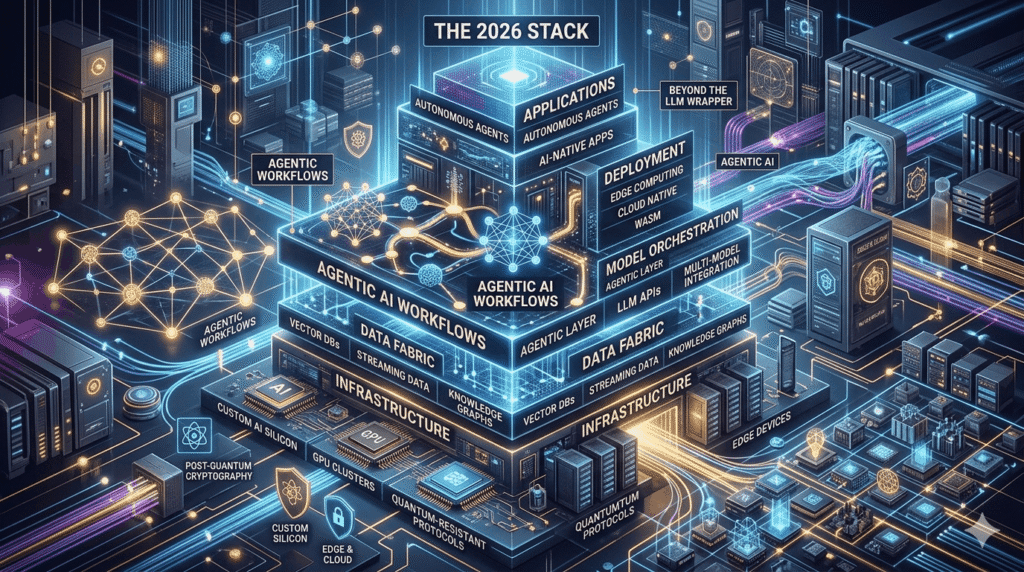
The “wrapper” era is officially over. In 2026, the focus for senior engineers and architects has shifted from simply querying LLMs to building robust Agentic Workflows and managing the infrastructure required to power them.
If you’re shipping code today, these are the technical shifts defining our current sprint.
1. The Move to Agentic RAG and Tool-Use
We’ve moved beyond simple Retrieval-Augmented Generation (RAG). The current standard is Agentic RAG, where the system doesn’t just fetch data but reasons about whether the retrieved context is sufficient.
- The Stack: Developers are moving from monolithic prompts to multi-agent orchestration (think advanced versions of LangGraph or CrewAI).
- The Challenge: Managing state and “infinite loops” in autonomous agents that can now call APIs and execute code independently.
2. Custom Silicon & Hardware-Aware Software
With Anthropic, Amazon, and Microsoft now deploying their own AI chips, the “one-size-fits-all” CUDA approach is fracturing.
- The Shift: We are seeing a rise in AI-Native compilers and frameworks that allow developers to optimize models for specific hardware architectures (TPUs vs. custom inferentia).
- Developer Impact: Understanding low-level hardware constraints is becoming a competitive advantage for backend and ML engineers.
3. Implementing Post-Quantum Cryptography (PQC)
The “Harvest Now, Decrypt Later” threat is no longer theoretical.
- Current Action: Development teams are beginning to migrate from RSA and ECC to NIST-standardized quantum-resistant algorithms (like ML-KEM).
- The Task: Auditing legacy crypto-libraries and ensuring your TLS stacks are ready for the larger key sizes required by PQC.
4. Edge Intelligence & “Small” ModelsThe trend of “bigger is better” has hit a wall of latency and cost.
- The Tech: We are seeing massive adoption of SLMs (Small Language Models) that run entirely on-device via WebGPU or specialized mobile NPUs.
- Why it matters: Users expect sub-100ms response times for AI-driven UI interactions, which the cloud simply can’t provide.
5. Green Ops: Carbon-Aware Scheduling
Sustainability is no longer just a PR move; it’s an infrastructure requirement.
- The Implementation: Modern CI/CD pipelines and Kubernetes clusters are increasingly using Carbon-Aware SDKs to schedule heavy training jobs or data processing during windows of peak renewable energy availability.